
MAY 2026
Will Agentic AI reflect the inherent complexity of architectural design?
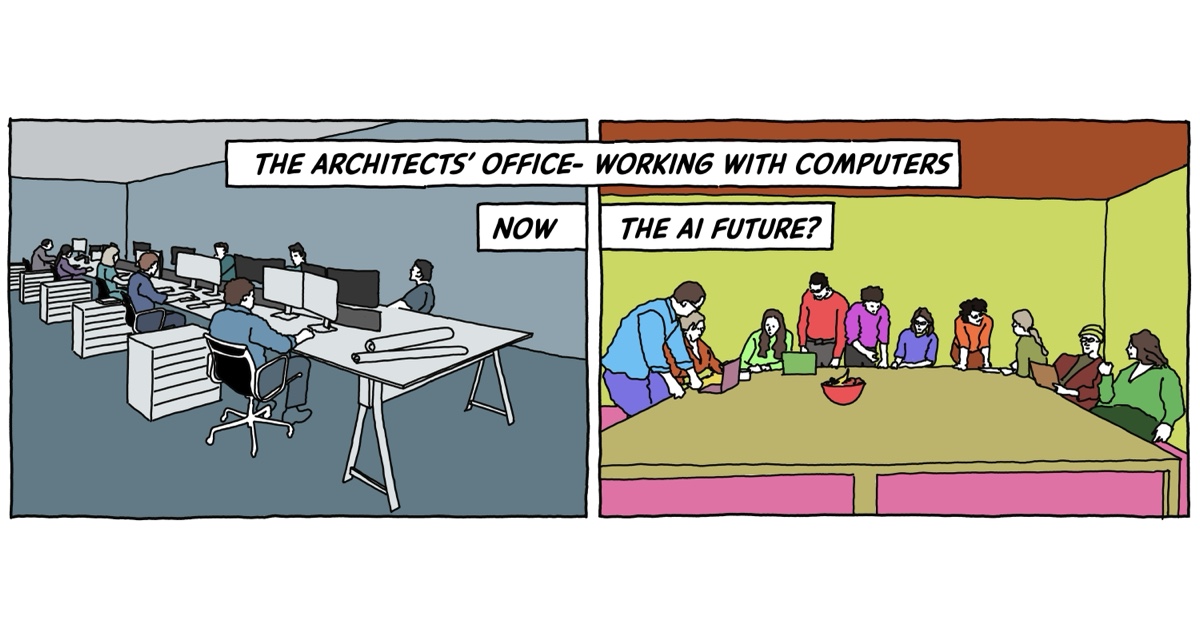
The architectural design process can be considered as the formulation and testing of ideas and the conversion of the adopted concepts into a built reality. Agentic artificial intelligence tools look as though they could potentially perform the conversion and testing roles, thereby reducing architects to the- admittedly essential- roles of the prompting and consideration of ideas and guidance of outcomes. But will those agentic AI tools properly reflect and incorporate the complexities of architectural design or will they be predicated on a more simplistic notion of how that occurs?
In his March 2026 article The agentic future of BIM in AEC Magazine Martin Day describes how agentic AI systems- which he describes as having multiple specialist AI agents working together to reach a solution- will be able to assimilate constraints upfront and from those generate viable outcomes. He describes those inputs as including codes, spatial logic, performance thresholds, cost parameters and system relationships. Day notes that this approach will not eliminate design but instead "shifts the design focus from drawing to declaring intent". Such intent includes objectives, spatial quality, performance targets, trade-offs, qualitative judgment and aesthetics. Day describes how current BIM processes model data first then perform checks later, and identifies the inversion that agentic AI systems will cause by first taking the declarations of intent and then generating iterations of the design.
"The designer remains responsible for judgement. The machine absorbs the combinatorial burden", Day states, adding the important observation that "however sophisticated generative tools become, architectural design still contains an irreducible element of human authorship, cultural context, and subjective judgement that resists formalisation in the way that load paths, cable routes, or pressure drops do not."
While underlining the improbability of reducing human creativity to machine steps, it could be that such analysis nevertheless suggests a linearity of action and response which is an over-simplification of the dynamics of architectural design. Will it really be possible to accumulate the inputs at the start in order for the AI to do its job? Or is life more complicated than that?
I have seen expressed many times that the progression of architectural design reflects what is commonly referred to as a waterfall diagram: there is an initial gathering of data, then the analysis of that that data, the subsequent formulation of a solution and then the implementation of that solution. That no doubt sounds familiar. It appears at first blush to be a logical and understandable description of the progression of architectural activities. The trouble is that more often than not architectural design just doesn't happen like that.
Much of an architect's early work deals with complex scenarios. Each project has its own idiosyncratic overlap of political, social, statutory and physical contexts, and the interaction of those with programmatic possibilities, stakeholder expectations and financial context means the initial conceptual basis of what we are doing has no obvious singular solution, but more likely a range of optimal potentials yet to be discovered. We can be faced with an evolving set of interlocking possibilities and constraints that may change over time. We may not be able to properly understand a problem until we develop and assess a solution. There are often many stakeholders who almost certainly don't agree with each other. Information may be missing because we haven't discovered it yet. Feedback necessary to confirm or question potential scenarios may be well in the future.
Accordingly there can be no simple progression of the design. Inputs can't be gathered together at the start to create a totality of opportunities and constraints to guide the design. Instead we navigate a circular interrelationship between input and design: inputs are needed to guide the design, but from the design we derive further information which supplement, replace or refine initial inputs. Typically we find that we just need to get stuck into design to allow us to explore and then better understand those inputs. In other words architectural design is always proceeding on the basis of incomplete information.
That means we cannot just plug in the brief and the parameters and let the AI rip.
Campbell Yule explored four propositions from Day's article in his April 2026 piece What the Prototypes Actually Showed. When considering Day's thesis of the designer being responsible for judgment, Yule concludes "professional judgment is what should determine when to invoke validation. Not a background process, not a continuous feed - but a deliberate call at a moment where the architect has enough context to evaluate the response critically, before a deliverable or at a point of genuine uncertainty… It's a better fit with how design decisions get made- iteratively, with periods of consolidation, not in a continuous real-time stream."
Yule arrives at that conclusion via his analysis of AI agents invoked by humans compared with those operating automatically. I agree with his statement, while arriving there along a different path, through the understanding of the inherent complexities of the architectural design process.
Let's look at those complexities. A good place to start could be the setbacks of buildings from site boundaries. It appears to be common for apps which could be grouped as "BIM 2.0" to use code setbacks as an input. One of Day's propositions tested by Campbell Yule is the idea of geometry as an output rather than input. In his assessment of that by testing the input of setbacks Yule notes that as an alternative to being typed in by humans, code setbacks could be read from a planning API, adding the comment that this would be "making the model a live response to regulatory data rather than a designer's interpretation of it." (As a side note that could lead to the disturbing potentials I identify in my 2024 article Will "Good Enough" Design Produced by AI Simply be Good Enough?).
If code setbacks were non-negotiable it would be simple to use those as a first step in determining the maximum building envelope. So simple, in fact, it would represent only the first couple of minutes of the design process. In decades of architectural practice, however, I rarely encountered such non-negotiable setbacks.
Planning schemes provide a strategic direction for broad swathes of land and uses. They deliberately do not delve into the idiosyncratic design possibilities that exist at the scale of the single site. Nevertheless good planning schemes provide a hierarchy of intended outcomes allowing opportunities for site-specific explorations to influence the planning scheme outcomes within the over-arching planning strategy.
Therefore setbacks are quite commonly flexible, even if the planning scheme prescribes a metric. Flexibility allows the creation through design of an outcome which will benefit both community and the development which otherwise might not be provided by strict adherence to the planning scheme. To realise those benefits requires persuading clients that the results will be worth the effort, the planning authorities to move away from previously adopted positions, and other stakeholders of the benefits of the variance. To attempt to carry out that persuasion is impossible without a scheme to analyse. To analyse the scheme without being able to recite every step taken- for every element of the scheme to be able to say why it is what it is- is just as impossible.
The progression of the design therefore needs to be carefully curated so that critical and influential aspects of the scheme are proposed, assessed and agreed before subordinate elements are considered, else much time, effort and expense could be expended for little or no benefit. Continuing our focus on setbacks, the design process will consider the possibilities and impacts of different building configurations for community and development value (and an assessment of our ability to persuade stakeholders to agree in principle to the schemes) then land on an optimal solution. The assessments will consider broad development metrics such as building area, height and efficiency of floor plate dimensions and attempt to quantify the benefits. What won't be looked at until much later will be more detailed design or metrics, because until the broader considerations are agreed that detail is unnecessary and distracting. For most building types, therefore, there is no need to consider at this stage, for example, fire sprinkler design or heating/cooling systems, as the costs or implications of those will not vary greatly for different building configurations. Considering those before they are relevant needlessly uses up human resources in a traditional process, and AI billing units in an AI workflow.
Setbacks are only one of many key influences which need to be explored through design, then negotiated and agreed before the design can embark on its finalisation phase. To add to the complexity these influences are not occurring one after the other, they are overlapping, and they will almost certainly affect each other. The resultant necessary curation has long predated AI, and the introduction of AI will not make that curation unnecessary. But while we know from long experience how to carry out design to take into account the complexity and interrelationships of as-yet unknown influences, we don't yet have the experience of how to do that in an AI workflow.
If this all seems a little abstract, let's consider a real project. The site is a full city block. There are no published setbacks or height limitations, but there are nevertheless expectations from the local council. The site contains a number of significant heritage buildings which will influence the design of the new buildings, as well as containing other older buildings with lesser heritage value which will probably be demolished- although there is no guarantee that demolition will be approved. There are no legislated principles for the adjacency of old and new- we will be relying on "good design" principles. The developer has aspirations which are greater than can be delivered on the site, and the local council has expectations which are much lower than should be delivered. The council has initial planning approval authority, but the project will almost certainly end up at the state planning tribunal. The stature of the heritage buildings means that state heritage tribunal hearings, independent of the planning tribunals but considering much of the same information, will be held in a parallel stream. The decisions of the heritage tribunal will have the same legal authority as the decisions of the planning tribunal, but those separate decisions may well contradict each other. A further statutory body with full legal powers has control over application of flood levels, need not take planning issues into account, and has no time limits on its considerations. The large site should be "knitted" into its context, but good urban design outcomes will inevitably conflict with heritage preservation needs, and so a commonality needs to be found. Each of these factors will have a significant influence on the fundamental formation of buildings, and none can be quantified at the start of the project.
In other words the only input which can be declared at the start is the site boundary. The rest of the inputs have to be gradually realised through design exploration, consultation and negotiation until we reach a basis that everyone agrees will be a starting point for the finalisation of the design. Thus we arrive back at Campbell Yule's statement speaking of periods of consolidation, not a continuous stream of AI activity.
The really important thing is that this needs to be led by people, not machines. People bring subjectivity and experience, emotions and curiosity. We create analogies to transform the ordinary into the extraordinary. We dream. We joke. If we wish to progress design from something rooted in past experience to possibilities not previously imagined, AI can assist, but the lead role will be ours.
With agentic AI taking care of the "combinatorial burden" the skill of the architect will be focussed on creation and fine-tuning of design instructions and enquiries and structuring the resultant explorations so that maximum design value is attained from the AI for a minimum of expense. A delightful aspect of AI is that the interface can represent a conversation. The act of design has always been primarily a social activity because the best results arise out of the interchange of ideas. Working with AI could in fact be the architect's nirvana: conversations between humans lead to focussed plain speech directions to the AI, which then "goes away" and works on the possibilities.
A difference between human-centric and the human/agentic AI design processes will be the retention of information about the design process. As Martin Day notes, in the human-centric approach, "designers carry intent in their brains, very much external to the software". By contrast the human/agentic AI model can store and recite the internal contest of intent, opportunities and constraints to inform future decision-making. Many of us have experienced a person leaving design team, and the impact that loss of project memory has on the collective understanding of the deliberations and decisions that have been taken. To have that memory retained could be significantly advantageous.
However in the gaining of that data-based memory what we have lost is the narration of intent. When we ask a human "Why did you take that step or propose that intervention?" the response is often as valuable as what has been proposed. Will the electronic archive be as immediate and comprehensible as an articulate verbal explanation- or even a hesitant and unsure response?
What hasn't been touched on here is the question of whether an agentic AI process will make people redundant or create different roles? That is clearly something that needs further analysis. What we can surmise, though, is the agentic AI architectural design processes are going to need some hefty and frequent human intervention.